


Last updated: 28 August 2025 — UK rules checked against GOV.UK and the Highway Code.
If you’ve ever wondered “Can I take my scooter on the road? Do I need to register it? What’s the speed limit on the pavement?”, this is your no-nonsense, plain-English guide. We’ll keep it friendly, practical, and bang up-to-date—so you’re confident (and legal) every time you head out.
Quick answer (the cheat-sheet)
- Class 2 = up to 4 mph, pavement/footpaths first; road only when there’s no pavement or to cross. No registration.
- Class 3 = up to 8 mph on the road (with a 4 mph limiter for pavements). Must be registered with DVLA (nil tax). No insurance required, but recommended.
- Where you can drive: pavements (max 4 mph), cycle tracks (yes), cycle lanes (no), bus lanes (no), motorways (never). Dual carriageways only with amber flashing beacon—and avoid ones over 50 mph.
- Who can use one: people who have trouble walking (or for demo/training/repair). No driving licence needed for Class 2/3.
- Eyesight: be able to read a car number plate at 12.3 m (40 ft) for Class 2/3 (advice).
Class 2 vs Class 3 (and why it matters)
Class 2 scooters (and powered chairs) top out at 4 mph and are designed for pavements and pedestrian areas. You can edge onto the road only if there’s no pavement or when crossing. No DVLA registration needed.
Class 3 models are the “road-legal” ones: up to 8 mph on the road, and they switch/limit to 4 mph on pavements. They must be registered with the DVLA (your dealer may do it for you), and you’ll receive a V5C logbook. Vehicle tax is £0 (nil). Insurance for Class 2/3 isn’t legally required but is recommended.
Mobility myth-buster: You don’t need a driving licence for Class 2/3. (Different story if the vehicle is “not in a class”—more on that in a second.)
Where you can (and can’t) drive
Pavements, footpaths, bridleways
- Max 4 mph and be courteous: give way to pedestrians, keep your speed down in busy areas, and don’t block paths when parked.
Cycle tracks vs cycle lanes
- Cycle tracks (physically separated from the road): OK for Class 2 & 3.
- Cycle lanes (painted on the road): not allowed.
This distinction matters, and GOV.UK calls it out explicitly.
Roads, dual carriageways, and motorways
- Class 3 can use most roads at up to 8 mph.
- Dual carriageways: fit an amber flashing beacon; avoid ones over 50 mph.
- Motorways: never.
- Bus lanes: no.
- Cycle-only lanes: no.
The “not in a class” scenario (rare, but important)
If a scooter/powered chair is faster than 8 mph, wider than 0.85 m, or heavier than 150 kg (or 200 kg with necessary medical equipment), it may be “not in a class.” In that case:
- Road-only (no pavements/cycle tracks).
- Driving licence required.
- Heavier vehicles must be insured.
This is niche—but it’s the rule.
Registration & tax (Class 3)
Brand-new road-legal models are often registered by the dealer. If not, you can do it yourself with form V55/MV; the DVLA leaflet INF304 explains what to include. Expect a V5C logbook afterwards. Tax is nil, but registration is still required.
Handy docs:
- V55/MV application and DVLA guidance.
- INF304 “Registering a mobility vehicle” (PDF).
Lights, indicators, horn: the kit you need on the road
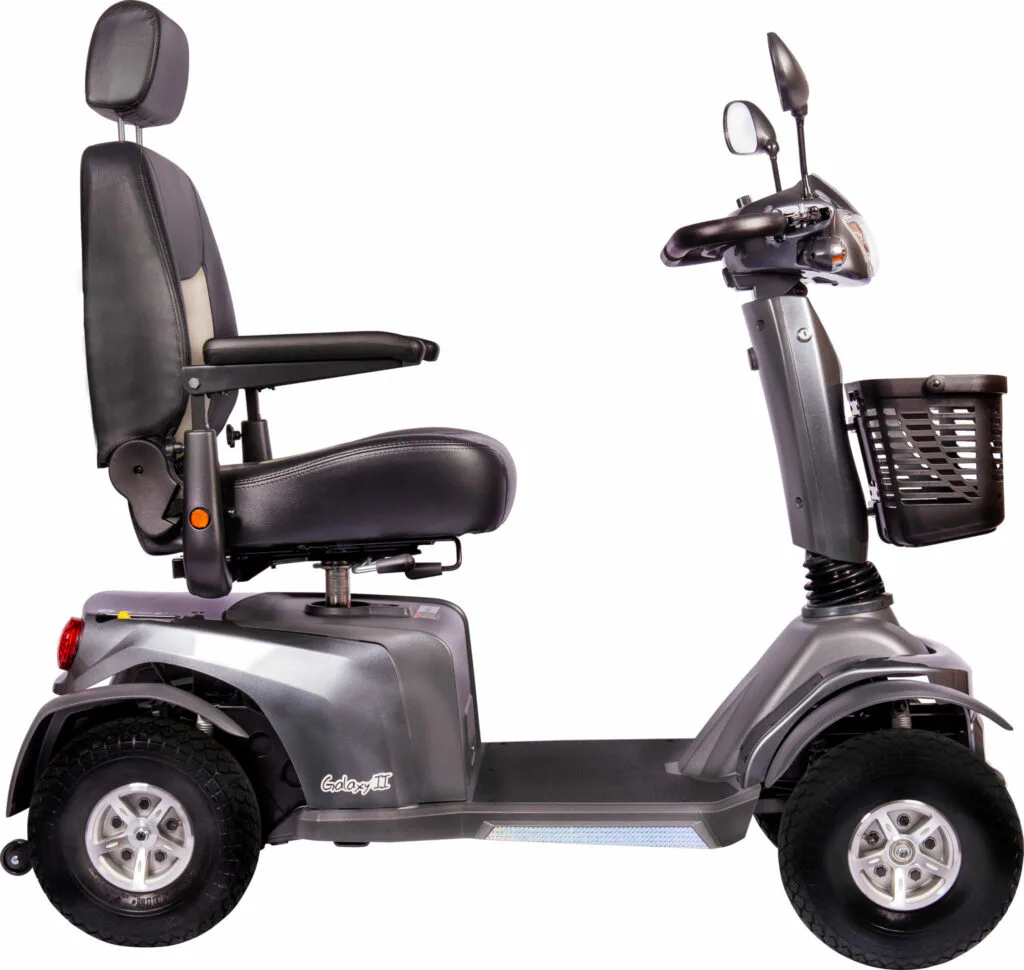
To legally use the road with a Class 3, your scooter/powered chair must have:
- Max speed at least 8 mph (with 4 mph limiter for pavements)
- Efficient brakes
- Front/rear lights & reflectors
- Direction indicators (can act as hazards)
- Rear-view mirror
- Audible horn
Tick those off before your first ride.
Eyesight & who can use a scooter
There’s no formal legal eyesight test for Class 2/3, but the government advises you should be able to read a standard car number plate at 12.3 m (40 ft). If your sight is borderline, get checked—if you cause an accident due to poor vision, you can be prosecuted.
You can use a scooter if you have trouble walking (injury, disability, medical condition). Able-bodied people may only drive one for demo/training or to/from repair.
Age for Class 3: Guidance and long-standing DfT material say 14+ for Class 3 road use.
Insurance: do you need it?
For Class 2/3: not legally required—but it’s strongly recommended (think: third-party, theft, and breakdown). If the vehicle is not in a class (heavier than 254 kg total), you must insure it.
Common scenarios (with straight answers)
- “Can I take my Class 2 on the road?”
Only where there’s no pavement or to cross. Otherwise, stick to pavements at 4 mph. - “Can I use the bike lane?”
Cycle lane (paint on road): no. Cycle track (segregated): yes. - “Can I go on the motorway?”
No. Ever. - “Dual carriageway—yes or no?”
If you must, fit an amber beacon, and avoid >50 mph roads. Personally: choose a safer route where possible. - “Do I need to register a Class 3?”
Yes—dealer usually does it; if not, use V55/MV. Nil tax. - “Do I need a licence?”
No for Class 2/3. Yes if the vehicle is not in a class.
Real-world tips (so your journeys are calm, safe, and legal)
- Set your limiter to 4 mph on pavements; it’s the law and it’s kinder to pedestrians.
- Be seen: use lights in poor visibility; reflective bits help in winter.
- Kerbs & crossings: use dropped kerbs; approach square-on; don’t rush it.
- Think route, not just destination: favour quieter streets or cycle tracks over busy roads where possible.
- Carry basics: phone, a small poncho, and a spare key. (Trust us on the spare key.)
- Check your tyres & batteries before longer trips—range anxiety is no fun.
Buying or upgrading? Start here (internal links)
- Shop Mobility Scooters (link to your Mobility Scooters category)
- Shop Powerchairs (link to your Powerchairs category)
- Folding & Boot Scooters (link to your Folding/Boot Scooters subcategory)
- Batteries & Chargers (link to your Mobility Scooter Batteries page)
- White-glove delivery & engineer set-up (link to your service page)
- VAT Relief (link to your VAT relief info page)
If you’re not sure which class fits your needs, our team can help you pick a model that’s legal for where you want to ride—and comfy for daily use.
Step-by-step: registering a Class 3 (DVLA)
- Ask your dealer to register (many will).
- If not, complete V55/MV (first registration) and follow INF304 guidance.
- Wait for your V5C (log book).
- Keep your paperwork handy if you ever sell the scooter.
Frequently asked questions
What’s the speed limit on pavements?
4 mph—for Class 2 and Class 3 when you’re off the road.
Can I ride in bus lanes?
No. Bus lanes and cycle-only lanes are off-limits.
Do I need insurance?
Not by law for Class 2/3, but it’s sensible to cover third-party risks, theft and breakdown. Not-in-class vehicles (heavier) must be insured.
Do I need number plates?
DVLA registration gives you a V5C log book. Your dealer can advise on displaying a mark/identifier—follow DVLA guidance in your paperwork.
Is there an age limit?
For Class 3 on the road, guidance sets 14+ for disabled users.
Who’s allowed to drive one?
People who have trouble walking (injury, disability, medical condition). Others may only drive for demo/training/repair.
Sources (outbound for your reference)
- GOV.UK — Classes, where you can drive, road kit, cycle tracks vs lanes, dual carriageways. GOV.UK+1
- GOV.UK — Pavements/parking rules. GOV.UK
- GOV.UK — Eyesight guidance. GOV.UK
- GOV.UK — Registration (V55/MV), insurance, nil tax. GOV.UK
- DfT guidance PDF — Age 14 for Class 3, road do’s/don’ts, construction features. GOV.UK
- Highway Code extract — Motorways off-limits; beacon on dual carriageways. GOV.UK
Final word (and a friendly nudge)
UK rules are actually pretty sensible once you split them into Class 2 vs Class 3 and pavement vs road. If you’re unsure which way to go, have a quick chat with our team—we’ll match the scooter to your routes, your home, and your confidence level. Then we’ll deliver and set it up properly so you’re rolling from day one.
Psst—want the easy route?
This guide is for England, Scotland and Wales. Northern Ireland has its own Highway Code—check local guidance if you live there.